Research areas at EIT to solve global challenges
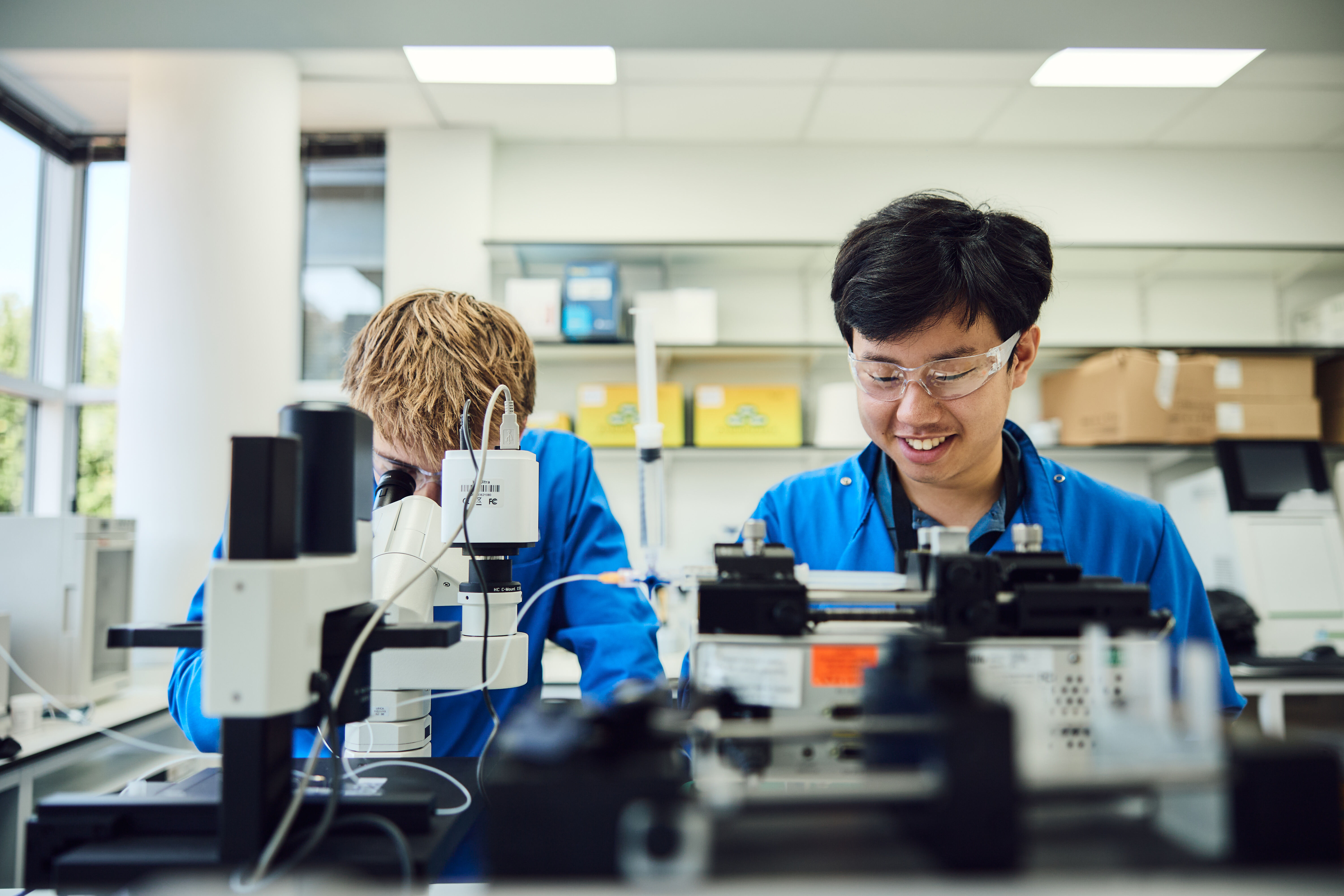
Drive innovation while studying at the University of Oxford as a fully-funded graduate
Pathogen Program
The Pathogen Program at EIT is developing a long-read based metagenomic diagnostic device, underpinned by a comprehensive pathogen genotype-phenotype database and in-cloud analytics, with the aim of enabling effective diagnosis, treatment and prevention of infectious disease in prioritised clinical applications.
There are several opportunities available for clinical and non-clinical candidates to work alongside the Pathogen Program across the following research areas:
- Characterising the genetic determinants of antimicrobial resistance
- Computational analysis of pathogen genomic diversity
- Assays for metagenomic sequencing from human and other samples
- Device engineering for automation and miniaturisation
Areas of interest include:
- Developing new computational tools for representing genomic and functional diversity across a broad range of pathogens to enable rapid interpretation of reads from metagenomic devices
- Discovering the genetic determinants and architecture of antimicrobial resistance across taxa that have been poorly studied to date
- Investigating new avenues for improving the sensitivity, accuracy, and robustness of assays for isolating genomic material from pathogens in diverse sample types
- Exploring innovative engineering solutions for automating and miniaturising complex molecular biology procedures in the preparation and nanopore sequencing of samples
In this interdisciplinary program there are opportunities for DPhil students from a range of disciplines including those with a clinical background, scientists with training in microbiology, genetics, epidemiology and biological sciences as well as applicants with highly developed quantitative analytical skills, including computer science, statistics and machine learning with interest in applications to infectious disease.
Oxford University supervisors for projects in this area are likely to be found in, but not limited to, departments within the Medical Sciences Division.
How to apply
The application process for Pathogen Program has two stages:
Stage 1: Apply to EIT
Submit an application to EIT by December 1, either for one of the published research projects below or with your own project proposal. We encourage you to apply early, as applications will be reviewed as they are received.
Stage 2: Apply to the University of Oxford
If selected by EIT, you will receive conditional funding and will be invited to apply to the University of Oxford and will be considered through the University’s graduate admissions process.
Research Projects
Optimising the implementation of metagenomic sequencing for lower respiratory tract and bloodstream infections through integrated epidemiological, behavioural and health-economic modelling
Virome metagenomics from clinical samples
Cell-state-aware AI for predicting antifungal treatment response and resistance emergence
AI for predicting and understanding antibiotic resistance in Mycobacteria: learning from genomes and protein structures.


Transforming how the world understands and responds to infectious disease.
Plant Biology Institute
As our demands on our global food system continue to grow, the Plant Biology Institute is driving research to produce more food with less land and fewer resources. The green revolution in the 20th century radically increased food production, enabled by new technologies, fertilisers and knowledge. Since then, improvements in productivity have not kept pace with the dramatic increase in demand on our food system. To feed a growing population and support better health outcomes, we need a second green revolution. We aim to deliver this revolution by developing impactful and commercially sustainable solutions for improving global food production and planetary health through pioneering plant science research.
Our areas of exploration include:
- Improve plant productivity through genetic innovation, for example by modifying pathways involved in controlling growth or resource allocation.
- Reduced reliance on external inputs, for example by engineering biological nitrogen fixation directly into plants.
- Novel low-carbon plant cell-based production platforms for food and medicines, for example by advancing plant cell-based agriculture.
- Advanced technologies that speed up discovery and deployment in plants, for example through novel transformation pipelines, automation of laboratory processes, and AI-driven phenotyping for rapid trait analysis.
DPhil students will work in a collaborative, interdisciplinary environment with access to state-of-the-art laboratory and plant growth facilities, and expertise across the EIT ecosystem.
We invite applications from individuals who are excited to tackle real-world challenges in agriculture through innovative science.
Oxford University supervisors for projects in this area are likely to be found in, but not limited to, one of the following departments: Biology; Chemistry; Statistics; Computer Science; Engineering Science or the Mathematical Institute.
How to apply
The application process for Plant Biology Institute has two stages:
Stage 1: Apply to EIT
Submit an application to EIT by December 1, either for one of the published research projects below or with your own project proposal. We encourage you to apply early, as applications will be reviewed as they are received.
Stage 2: Apply to the University of Oxford
If selected by EIT, you will receive conditional funding and will be invited to apply to the University of Oxford and will be considered through the University’s graduate admissions process.
Research Projects
Engineering carbon allocation in plant cells
Molecular regulation of terpene biosynthesis

Feeding the world’s growing population in the face of climate change by enabling every farm on earth to produce more food with fewer resources and less land.
Materials & Devices for Life Sciences
The Materials & Devices for Life Sciences Institute (MDLS) at EIT is led by Professor Hagan Bayley and a team with decades of outstanding scientific achievement in biological engineering and its applications. Our research programmes in Nanopore Sensing and Tissue Construction aim to diagnose, prevent, treat, and better understand disease in ways that current technologies cannot.
The technologies we will develop address unmet needs in diagnostic, clinical, and pharmaceutical settings, while also serving as next-generation research tools that accelerate scientific discovery.
MDLS has opportunities for DPhil candidates spanning fundamental science through to device engineering:
Nanopore Sensing
- Applications for polypeptides and their modifications, glycans, and small molecules
- Versatile nanopore devices for sensing, sequencing, and beyond
Tissue Construction
- 3D tissue engineering with stem cells
- Synthetic and hybrid tissue engineering
- Devices for advanced tissue engineering
We welcome candidates from a broad range of scientific backgrounds, including chemistry, biochemistry, biology, materials science, physics, and engineering. Our research is interdisciplinary and technique-agnostic, drawing on the experimental and computational approaches best suited to each scientific challenge.
Oxford University supervisors for projects in these areas are likely to be based across a range of departments, including Biochemistry, Biology, Engineering Science, Materials, Physics, and Physiology, Anatomy and Genetics (DPAG).
How to apply
The application process for Materials & Devices for Life Sciences has two stages:
Stage 1: Apply to EIT
Submit an application to EIT by December 1, either for one of the published research projects below or with your own project proposal. We encourage you to apply early, as applications will be reviewed as they are received.
Stage 2: Apply to the University of Oxford
If selected by EIT, you will receive conditional funding and will be invited to apply to the University of Oxford and will be considered through the University’s graduate admissions process.
Research Projects
Engineering 3D brain circuits for modelling neurodegenerative diseases
Biocomputing with 3D printed neural tissues
3D cardiac Tissues integrated with soft iontronic devices
Developing a human Biomimetic 3D platform to model deep tissue bacterial infections
Next-generation nanopore technologies for biomolecular analysis and diagnostics
Programmable membrane proteins for nanoscale transport and sensing

Applying multidisciplinary research to redefine nanopore technologies and progress new approaches in tissue engineering that will impact personalised diagnostics and therapeutics.
Economics
EIT possess a large economics team aimed at tackling issues around how society and the economy will adapt to AI and Robotics. It provides a first rate research environment, a team environment and access to world leading experts in these areas. As well as these research strengths the team has high level access to global policy makers and corporations around the world. The consequence is an end to end research agenda driving from fundamental research through to policies and products and their implementation.
The Economics Group welcomes applications from students interested in pursuing a DPhil in one of the following topics:
The Economic Consequences of AI and Robotics
Rapid technological change in AI and Robotics is likely to have significant impact on a range of economic variables – from GDP and productivity through to employment, inequality and public finances. The aim of this work is to develop theoretical and empirical models to understand this impact, identify and calibrate the mechanisms at work, determine how different forms of technological change have different impacts and what are the optimal policy responses.
Oxford University supervisors for projects in this area are likely to be found in, but not limited to, the Economics department.
How to apply
The application process for Economics has two stages:
Stage 1: Apply to EIT
Submit an application to EIT by December 1. You can apply with your own project proposal that aligns with the program's research aims and areas of interest outlined above. We encourage you to apply early, as applications will be reviewed as they are received.
Stage 2: Apply to the University of Oxford
If selected by EIT, you will receive conditional funding and will be invited to apply to the University of Oxford and will be considered through the University’s graduate admissions process.
APPLY NOW

Applying economic tools and thinking to society’s enduring challenges, by shaping the strategies, markets and policies needed to scale the best solutions.
AI & Robotics
The AI & Robotics CDT’s aim is to advance EIT’s mission by harnessing and developing approaches that lead to real-world breakthrough impact. We’re combining foundation models with the latest robotic hardware to drive high-speed, AI-guided experiments to help shorten the research cycle from idea to result. We collaborate across disciplines and borders, building tools, systems and programs that harness the immense powers of rigorous minds and data technology to create a better future.
- Building machine learning interatomic potentials (MLIP)-powered simulations for large-scale biomolecular systems by developing multiscale capabilities, novel training methods and faster sampling algorithms
- Unlocking the next generation of multimodal foundation models and agents across text, imaging and molecular data to accelerate Science discovery
- Combining the power of large language models and scientific domain tools to design end-to-end scientific solutions for experimental design
- Develop methods for foundation model training and understanding to enable EIT’s mission
How to apply
Applications to the CDT in Fundamentals of AI are made directly to the University of Oxford and will open soon. Learn more on the Fundamentals of AI website.

Harnessing state-of-the-art statistical machine learning to accelerate impact in EIT’s programs and discover novel AI approaches that lead to breakthrough impact.
Generative Biology Institute
The vision of the Generative Biology Institute (GBI) is to lay the foundations for engineering biology and unlock its potential for good. To achieve this, we must overcome two key challenges. First, we need the ability to write in the natural language of biology, enabling the rapid and scalable synthesis of entire genomes with precision. Second, we must understand what to write in DNA, determining which DNA sequences will generate biological systems that perform the desired functions. Addressing these challenges will allow us to harness the full power of biology to create transformative solutions across health, agriculture, clean energy and more. GBI is focused on solving the two critical challenges in making biology engineerable and applying the solutions to addressing the global challenges encapsulated in EIT’s humane endeavours.
Oxford University supervisors for projects in this area are likely to be found in, but not limited to, departments within the Mathematical, Physical & Life Sciences Division, including Chemistry; or departments from within the Medical Sciences Division.
For more information on the Generative Biology Doctoral Training Programme and a list of available projects, please visit their website.
How to apply
Applications to the Doctoral Training Programme in Generative Biology are made directly to the University of Oxford. For information on how to apply, please visit here.
.png)
Building a faculty of leading researchers to tackle the key challenges in making biology engineerable and unlock its potential to benefit humanity.
Correlates of Immunity
In partnership with the University of Oxford, the Correlates of Immunity (COI)-AI program has several opportunities available for outstanding clinical and non-clinical candidates.
CoI-AI brings together experimental medicine, cutting-edge immunology, microbiology and artificial intelligence to better understand how the human immune system protects against infection and accelerate the development of next-generation vaccines.
DPhil research opportunities are available across areas including:
- Developing novel controlled human challenge models
- Analytical immunology, including mucosal immunity
- Microbiology and host-pathogen interactions
- Computational biology and AI to identify immune correlates of protection and enable biomarker discovery.
The programme focuses on tacking bacterial diseases that are a top cause of global mortality, for which traditional vaccine development approaches remain inadequate or have failed, including S. aureus, E. coli (ExPEC), Group A strep, gonococcus and pneumococcus.
In this interdisciplinary programme there are opportunities for DPhil students from a range of disciplines including those with a clinical background, scientists with training in immunology or microbiology, as well as applicants with highly developed quantitative analytical skills, including computer science, statistics and machine learning with interest in immunology and clinical applications.
Example research projects span clinical research, microbiology, immunology, antigen discovery and computational research, and can be tailored to successful applicants’ backgrounds, interests and career aspirations.
The CoI-AI Programme is based at the Oxford Vaccine Group, University of Oxford, and is co-led by Professor Sir Andrew Pollard and Professor Daniela Ferreira.
How to apply
The application process for the Correlates of Immunity (COI)-AI program has two stages:
Stage 1: Application
Submit an application by 16 November, either for one of the example research projects below or with your own project proposal. We encourage you to apply early, as applications will be reviewed as they are received.
Stage 2: Apply to the University of Oxford
Selected candidates will be invited to apply to the University of Oxford and will be considered through the University’s graduate admissions process.
APPLY NOW
Please note the research projects listed below are examples only.
Research Projects
Discovery of antigenic targets and correlates of protection for next generation gonorrhoea vaccine development
AI-guided discovery and structure-informed engineering of Staphylococcus aureus antigens using human nasal-colonisation immune signatures
AI-guided discovery and structure-informed design of serotype-independent pneumococcal protein antigens using human challenge immune signatures
Decoding protective immunity against extraintestinal Escherichia coli infection

Pursuing a new leap in antibody and vaccine discovery through advanced immunology, artificial intelligence and high-quality data.
Register for an information session
Explore the programme further by joining our online webinars, where you can meet the team and learn more about the scholarships.
Sign up to our newsletter
Whether you're a potential applicant or part of an aligned organisation, our newsletter is the best way to stay up to date with our programme.